
Among them was P Venugopalan, leading designer of the propulsion systems for Prithvi, Agni and BrahMos missiles.

During last week's Nuclear Security Summit, President Obama asked the media to leave and then screened videos depicting plausible scenarios pertaining to nuclear terrorism.

Some parties complained to the Election Commission alleging violation of the model code.
'Given Chinese sensitivity to anything to do with Tibet -- and the fact that in the 1950s it was the Tibet issue which led to the deterioration of India-China relations and the border war in 1962 -- India should be particularly careful in not triggering a Chinese reaction which it may not be able to handle,' says former foreign secretary Shyam Saran.
The new minister must commit himself to supporting long-term defence plans or else defence modernisation will continue to lag and the growing military capabilities gap with China will assume ominous proportions, warns Brigadier Gurmeet Kanwal (retd).

Parliament on Tuesday hailed A P J Abdul Kalam as the "real gem" of India, saying the death of the former President has taken away its "true son" who became the driving force behind the country's space and missile programme.
His remarks came days after Beijing raised eyebrows over India testing 5000 km-range Agni 5 missile which has entire China within its reach.

Dhanteras, the prime minister said, has become even more special.
The IAF faces a 'fighter gap' of 13 squadrons. The IAF would be caught seriously short in a two-front war -- the worst-case planning contingency in which China and Pakistan attack India simultaneously, points out Ajai Shukla.
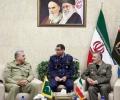
'Tehran senses that the Modi government is inexorably gravitating toward the US-Israeli-Saudi axis, jettisoning India's traditional independent Gulf policies,' notes Ambassador M K Bhadrakumar.
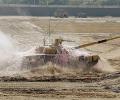
The prospects of India becoming a credible manufacturer of defence platforms or major weapon systems for export are remote, says Vice Admiral Premvir Das (retd).

'With two nuclear neighbours, how likely is it for our armed forces to battle in a contaminated environment that could include nuclear, biological or chemical attacks by the adversary?' 'Are we prepared for the threat?' Brigadier S K Chatterji (retd) explains the meaning and significance of Operation Vijay Prahar.

The Mars mission is overwhelmingly irrelevant to space science and won't advance the frontiers of knowledge. It will divert attention from the real technological challenges facing the Indian space programme, and will further distort our science and technology priorities, says Praful Bidwai.
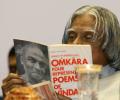
'His simple lifestyle, his optimism, his hard work and his genuine humility made him an authentic role model to millions of children, many of them growing up in challenging circumstances.'

Dr P K Menon, Chief Scientist and CEO, Optimal Synthesis Inc, who worked with Dr A P J Abdul Kalam early on in his career, recalls what it was like working for his first boss.

One thing Beijing must understand is that India is not obsessed with being a threat to China but only wants a rightful place for itself in the world, says Sanjeev Nayyar.

Indian policymakers must incorporate in their nuclear doctrine a realistic response to tactical nuclear warheads, says Ajai Shukla.

Two lessons from the closure of the Barak investigation: be careful with investigations, and buy from the US or Russia through transparent protocols. Premvir Das examines

Dr Kalam, the scientist with the poet's heart, started the journey of his life from a small town in Tamil Nadu.

'New Delhi showed itself willing -- at least for a period -- to tolerate the risk of conflict and to withstand Beijing's implicit and explicit threats.' 'But it also continued to try to cut some kind of deal with China to reduce tensions.'
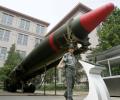
Despite four disarmament section talks and six strategic dialogues between the two foreign ministries, China's intransigence on recognising Indian nuclear status resulted in no confidence building measures in the nuclear field between the two, says Srikanth Kondapalli.
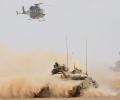
'Offensive operations to capture objectives across the LoC to eliminate terrorist launch pads and deny the use of the most dangerous routes of infiltration, are likely to be limited to brigade-level attacks.' 'These limited operations are unlikely to escalate to war across the international boundary,' says Brigadier Gurmeet Kanwal (retd).

'Only when India's adversaries are convinced that India has both the necessary political and military will and the hardware to respond to a nuclear strike with punitive retaliation that will inflict unacceptable loss of human life and unprecedented material damage, will they be deterred,' says Brigadier Gurmeet Kanwal (retd).
'It seems likely that the February 2019 crisis is over.'

Flexible, maneuverable, mobile and swift, the M-777A2 Ultra-Light Howitzers are just what India needed to replace its aging battle-tested Bofors guns, says Debalina Ghoshal.

'President Kalam pitched his dreams high. He will be best remembered for that feat.'
